Credentialing for Therapists: The Complete Guide to Getting (and Staying) In-Network
A practical guide to insurance credentialing for therapists—timelines, common delays, re-credentialing, and how better provider communication fits in.
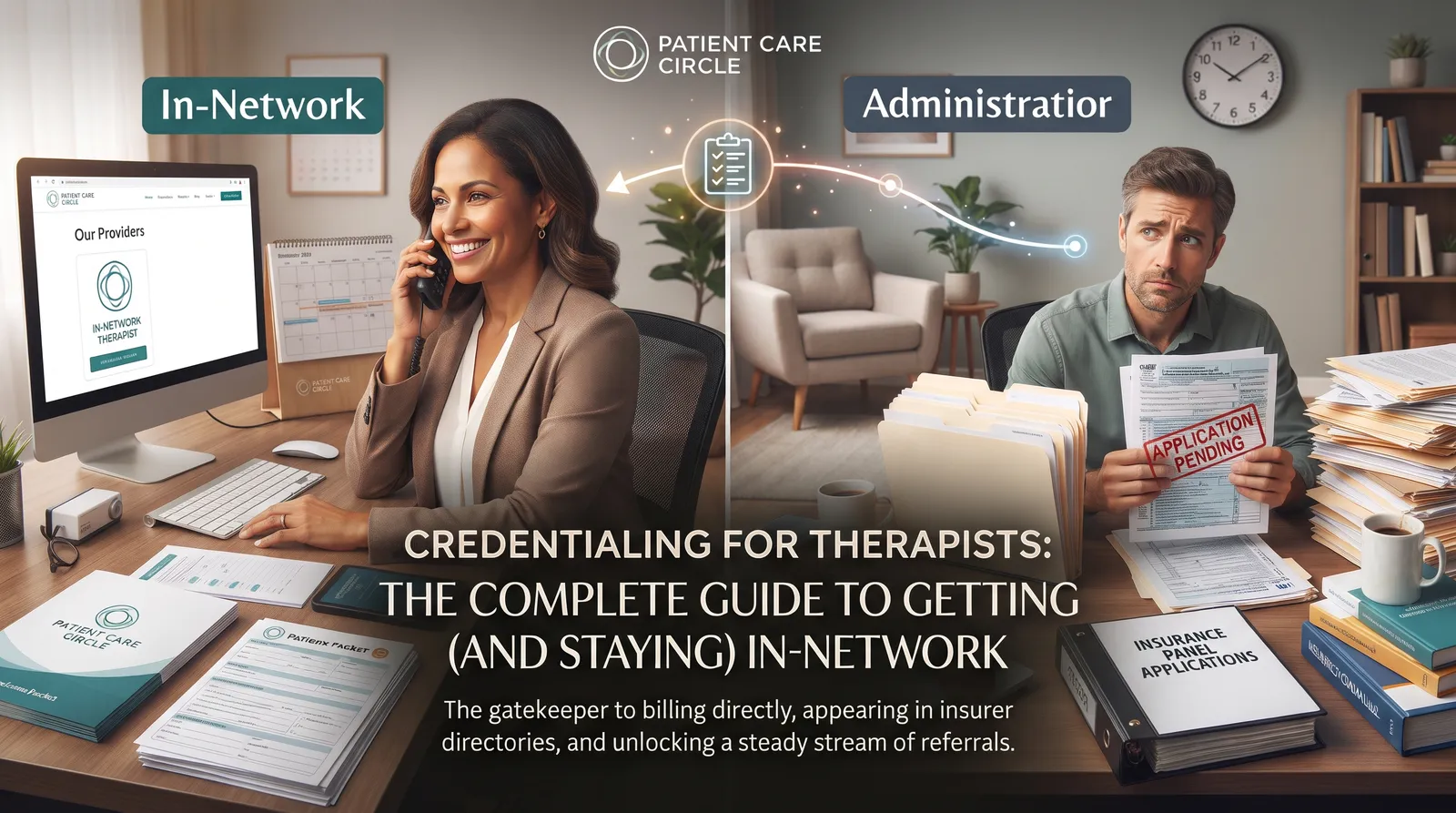
If you're a private-practice therapist thinking about joining insurance panels, credentialing is the gatekeeper. It's the process that lets you bill insurers directly and appear in their directories as an in-network provider. Done well, it opens a steady stream of referrals. Done poorly—or without a plan for what comes after—it becomes a months-long administrative slog followed by a lifetime of paperwork.
This guide walks through credentialing from first application to ongoing maintenance, with an honest look at timelines, common delays, telehealth wrinkles, and what billing looks like once you're approved. It also covers something most credentialing guides skip entirely: what happens to your day-to-day communication workload once you're in-network and the referrals start coming.
A quick disclaimer: Patient Care Circle is a communication tool and not a substitute for clinical judgment or emergency services. Nothing here is legal, billing, or compliance advice—verify specifics with each payer and your state board.
What Credentialing Actually Means for Therapists (and How It Differs from Licensing)
People use "licensing" and "credentialing" interchangeably, but they're different steps handled by different bodies.
- Licensing is granted by your state licensing board. It's what authorizes you to practice as an LPC, LMHC, LCPC, LMFT, LCSW, or similar title in that state. Without it, you can't practice at all.
- Credentialing is the process an insurance payer (like a commercial plan or a Medicaid managed-care organization) uses to verify your qualifications before letting you join their network. It's payer-specific—being credentialed with one insurer tells you nothing about your status with another.
- Enrollment (sometimes called contracting) is the step where you actually sign a participation agreement and get loaded into the payer's system with a reimbursement rate and an effective date.
In short: licensing says you can practice; credentialing and enrollment say a given insurer will pay you to. You can be fully licensed and still unable to bill a single commercial plan until you've gone through each one's credentialing pipeline.
The Credentialing Process, Step by Step
While every payer has quirks, the backbone of the process is fairly consistent:
- Get your NPI numbers. You'll need an individual Type 1 NPI (National Provider Identifier). If you bill under a group or business entity, you'll also need a Type 2 NPI for the organization. These are free through the NPPES registry.
- Build and attest your CAQH profile. CAQH ProView is the centralized database most commercial payers pull from. You'll enter your education, work history, licenses, malpractice coverage, and more—then attest (confirm it's current). Payers can't verify you if your CAQH profile is incomplete or unattested.
- Choose and apply to payers. Identify the panels you want to join (more on choosing wisely below) and submit each payer's credentialing application. Some pull directly from CAQH; others want their own forms.
- Primary source verification. The payer independently verifies your license, education, board status, malpractice history, and sanctions directly with the original sources. This is often where the clock ticks longest.
- Committee review and contracting. Once verified, your file goes to a credentialing committee. If approved, you receive a participation contract specifying your reimbursement rates and effective date. You generally cannot bill as in-network until that effective date—even if you've been approved.
Keep copies of everything: your CV, license, malpractice face sheet, diplomas, and a running log of every application with submission dates and contact names.
How Long Credentialing Really Takes
The honest answer is: longer than you'd like, and it varies. Timelines depend on the payer, your state, how complete your application is, and whether the panel is even accepting new providers.
As a general rule of thumb discussed across the industry, initial credentialing commonly takes somewhere in the range of a few months per payer—and it can run longer when verification stalls or documents are missing. [SOURCE NEEDED: current average credentialing timeline ranges by payer]
A few practical takeaways:
- Start early. If you're launching a practice, begin credentialing before you need the income, because you can't bill in-network retroactively in most cases.
- Apply to multiple payers in parallel, not one at a time.
- Expect variability. Two therapists applying to the same payer in the same week can have very different experiences based on completeness and workload at the payer.
Rather than anchoring on a specific day count, plan for a multi-month runway and build your cash-flow expectations around it.
Common Reasons Credentialing Gets Delayed or Rejected
Most delays are avoidable. The usual culprits:
- Incomplete or un-attested CAQH profiles. Missing work-history dates, gaps that aren't explained, or an attestation that's lapsed.
- Expired documents. An expired malpractice policy, license, or CPR certification can freeze the whole file.
- Missing malpractice information. Payers want current coverage details and often minimum coverage limits.
- Closed panels. Some networks simply aren't accepting new providers in your area or specialty. This isn't a rejection of you—but it does mean you'll need to ask whether and when the panel might reopen, or appeal with a case for why you're needed (e.g., an underserved specialty or language).
- Mismatched information. Discrepancies between your application, CAQH, and primary sources trigger manual review and back-and-forth.
- Unanswered follow-ups. Payers often email a single request for a missing item. Miss it, and your file can sit for weeks.
The best defense is a tidy, consistent document set and a system for catching payer follow-ups quickly.
Choosing Insurance Panels: What to Weigh Beyond Reimbursement Rates
Reimbursement rate matters, but it's not the only factor—and chasing the highest rate onto a panel that's a bad operational fit can cost you more than it earns. When evaluating the best insurance panels for therapists in your situation, weigh:
- Panel status. Is it open in your area? A high rate on a closed panel is irrelevant.
- Client demand. Which plans do the clients in your community actually carry? Matching your panels to local demand keeps your schedule full.
- Administrative burden. Some payers are notorious for claim denials, prior-authorization requirements, or clawbacks. A slightly lower rate with clean, fast payment can net out better.
- Reimbursement and payment timeliness. Look at both the fee schedule and how reliably and quickly the payer pays.
- Specialty alignment. Payers serving populations you're trained to help (e.g., Medicaid for community mental health, EAPs, or specific commercial plans) can be a strong fit.
A smaller set of well-chosen panels you can manage cleanly often beats a long list you can't keep up with.
Telehealth Credentialing Considerations
Telehealth expanded payer networks significantly, but credentialing for it adds complexity—and the rules are highly state- and payer-specific.
A few general points to verify rather than assume:
- Some payers require you to be credentialed and enrolled to deliver services to members in the state where the client is located, not just where you sit.
- Certain plans have distinct telehealth billing requirements, place-of-service codes, or modifiers.
- Cross-state practice may require additional licensure (such as participation in an interstate compact) before a payer will enroll you for telehealth in that state.
Because these requirements change and differ by jurisdiction, confirm the current rules with each payer and your state licensing board before relying on them. [SOURCE NEEDED: state-specific telehealth credentialing rules to include]
This section touches on state-specific compliance and licensure questions—verify details with your board and payers.
Staying Credentialed: Revalidation and Ongoing Maintenance
Getting credentialed isn't the finish line—it's the start of an ongoing maintenance cycle. Letting it lapse can drop you out of network and interrupt your payments.
Typical maintenance tasks include:
- Re-attesting your CAQH profile on a recurring basis so payers keep pulling current data. Confirm the current re-attestation cadence before relying on a specific interval. [SOURCE NEEDED: CAQH re-attestation period]
- Payer revalidation / re-credentialing on each payer's own cycle. Many payers re-credential participating providers periodically; the exact cadence varies by payer and program. [SOURCE NEEDED: payer-specific revalidation cycles]
- Keeping documents current—malpractice policy, license renewals, and any certifications—and updating them in CAQH and with payers promptly.
- Updating demographic changes—a new office address, phone number, group affiliation, or tax ID—so directories and claims stay accurate.
Build a simple calendar of renewal and re-attestation dates. A missed deadline is one of the easiest and most costly mistakes to make.
What Pricing and Client Billing Look Like Once You're In-Network
Once you're in-network, your fees are largely governed by your contracted rates rather than your private-pay rate. Understanding the pieces helps you set expectations with clients and keep cash flow steady.
Key concepts:
- Contracted (allowed) amount. The negotiated rate the payer recognizes for a service code—often less than your standard private-pay fee.
- Client responsibility. Copays, coinsurance, and deductibles are the portion the client owes. Collecting these at the time of service is a cornerstone of healthy client billing and client payment practices.
- Verification of benefits. Checking eligibility and benefits before the first session prevents surprises for both you and the client.
- Superbills for out-of-network clients. If you stay out-of-network with some payers, a superbill lets clients seek partial reimbursement themselves.
- Sliding scale and private pay. Many practices keep a limited number of reduced-fee or private-pay slots alongside insurance work.
Clients frequently ask about the average cost of a counseling session, and the honest answer is that it varies widely by location, provider credentials, and whether insurance is involved. Rather than quote a figure that may be inaccurate for your area, it's best to point clients to their specific plan benefits and your posted fees. [SOURCE NEEDED: typical average therapy session cost ranges to cite accurately or decide to omit specific numbers]
After Credentialing: Why Provider Communication Still Matters
Here's the part most credentialing guides never mention. Getting in-network doesn't just unlock billing—it changes your workflow. In-network status means more referrals, more shared clients, and more providers you need to coordinate with: primary care physicians, psychiatrists, other therapists, case managers, and sometimes the payers themselves requesting documentation.
That coordination is where a lot of private practices quietly lose time. Referrals arrive by fax. A psychiatrist's office plays phone tag with yours. A records request lands with an unclear deadline. None of it is clinically complicated, but it adds up—and fragmented, scattered communication is easy to drop when you're carrying a full caseload.
This is the friction Patient Care Circle is built to reduce. PCC is HIPAA-compliant secure messaging designed specifically for behavioral-health providers who coordinate care around shared clients. Instead of faxes, voicemails, and phone tag, you have a shared care circle for provider-to-provider communication, secure document and referral sharing, and a cleaner record of who was told what and when. The goal isn't to replace your clinical judgment—it's to cut the fragmented-communication overhead that grows right alongside your panel.
So as you plan your credentialing runway, plan for the coordination load that follows it, too. Getting in-network is step one; staying organized once the referrals arrive is what keeps your practice sustainable.
FAQ
How do you become a certified credentialing specialist?
Credentialing specialists typically pursue certification through professional organizations that offer credentialing-focused credentials, usually after gaining experience in provider enrollment, payer processes, and primary source verification. Requirements and exams vary by certifying body, so review the current eligibility criteria directly with the organization you're considering. [SOURCE NEEDED: specific certification programs and requirements for credentialing specialists]
Is an LPC the same as a therapist?
"Therapist" is a general term for a range of licensed mental-health professionals. An LPC (Licensed Professional Counselor) is one specific license type that practices therapy. Other therapists hold different licenses—such as LMHC, LCPC, LMFT, or LCSW—depending on the state and training path. So an LPC is a therapist, but not every therapist is an LPC.
How long does insurance credentialing take for a new therapist?
It generally takes several months per payer, and it varies by insurer, state, and how complete your application is. The cleanest way to shorten it is to apply early, submit a complete and attested CAQH profile, and respond quickly to any payer follow-ups. [SOURCE NEEDED: current average credentialing timeline ranges by payer]
Can you see clients while credentialing is in process?
You can often see clients, but how you can bill is the key question. In most cases you cannot bill a payer as in-network before your effective date, and in-network billing is generally not retroactive. Some clinicians see clients as private-pay or out-of-network during the wait. Confirm the specifics with each payer before relying on this.
Do you need to re-credential with every insurance panel separately?
Yes. Credentialing and re-credentialing are payer-specific. Each insurer runs its own cycle, so you'll maintain and revalidate with each panel independently—another reason to keep a shared calendar of every payer's deadlines. [SOURCE NEEDED: payer-specific revalidation cycles]
Frequently asked questions
How do you become a certified credentialing specialist?
Credentialing specialists typically pursue certification through professional organizations that offer credentialing-focused credentials, usually after gaining experience in provider enrollment, payer processes, and primary source verification. Requirements and exams vary by certifying body, so review the current eligibility criteria directly with the organization you're considering.
Is an LPC the same as a therapist?
"Therapist" is a general term for a range of licensed mental-health professionals. An LPC (Licensed Professional Counselor) is one specific license type that practices therapy. Other therapists hold different licenses such as LMHC, LCPC, LMFT, or LCSW depending on the state and training path. So an LPC is a therapist, but not every therapist is an LPC.
How long does insurance credentialing take for a new therapist?
It generally takes several months per payer, and it varies by insurer, state, and how complete your application is. The cleanest way to shorten it is to apply early, submit a complete and attested CAQH profile, and respond quickly to any payer follow-ups.
Can you see clients while credentialing is in process?
You can often see clients, but how you can bill is the key question. In most cases you cannot bill a payer as in-network before your effective date, and in-network billing is generally not retroactive. Some clinicians see clients as private-pay or out-of-network during the wait. Confirm the specifics with each payer before relying on this.
Do you need to re-credential with every insurance panel separately?
Yes. Credentialing and re-credentialing are payer-specific. Each insurer runs its own cycle, so you'll maintain and revalidate with each panel independently, which is another reason to keep a shared calendar of every payer's deadlines.