Secure Texting in Healthcare: What "HIPAA-Compliant" Actually Requires (2026 Guide)
A plain-spoken guide to secure texting for healthcare: what HIPAA requires, how platforms differ, and what private-practice therapists should check first.
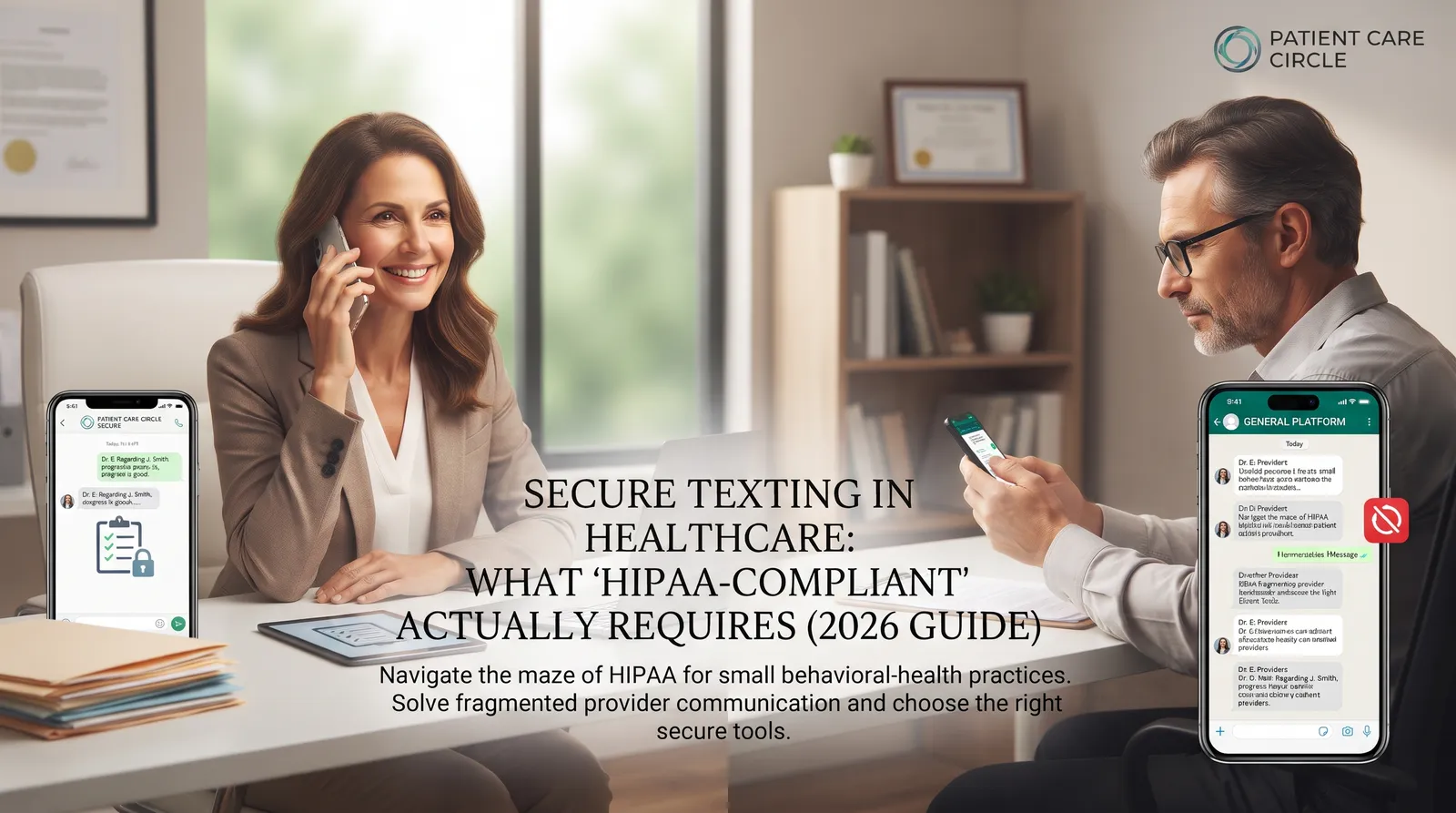
If you run a private therapy practice, you've probably been told to "use secure texting" when you coordinate with a psychiatrist, primary care provider, or another clinician who shares a patient with you. It's good advice. But most of the guidance you'll find online is written for hospital IT departments comparing enterprise paging systems — not for a solo clinician who just needs to send a referral note without using a personal cell phone.
This guide is for the small side of the field. We'll explain what "HIPAA-compliant" actually requires in plain language, why fragmented provider-to-provider communication is the real problem worth solving, and how to evaluate tools — including the general-purpose platforms many therapists search for — against what a behavioral-health practice actually needs.
A quick note before we start: this is educational information, not legal or compliance advice. For decisions about your specific practice, confirm requirements with a qualified compliance professional or attorney.
What "Secure Texting" Means in Healthcare (and Why HIPAA Compliance Isn't Optional)
"Secure texting" sounds like a product feature, but in healthcare it's really shorthand for a handful of specific protections around protected health information (PHI) — any information that could identify a patient and relates to their health, care, or payment for care. A patient's name alongside an appointment, a diagnosis in a referral note, even a message that reveals someone is your client: that's PHI.
Ordinary text messages and most consumer chat apps aren't built to protect PHI the way the HIPAA rules expect. A few terms come up constantly:
- PHI (protected health information): the health data HIPAA is designed to safeguard.
- BAA (business associate agreement): a contract between your practice and a vendor that handles PHI on your behalf (like a messaging platform). If a vendor won't sign one, that's a meaningful signal.
- Encryption: scrambling data so it can't be read if intercepted — both while it travels ("in transit") and while it's stored ("at rest").
The reason compliance isn't optional is simple: HIPAA applies to covered entities and their business associates regardless of practice size. A solo therapist is held to the same core expectations around safeguarding PHI as a large clinic. The scale of what you implement differs; the obligation doesn't.
[Needs clinician review] This section describes HIPAA concepts in general terms for education only. Please confirm the specific definitions and requirements with the clinical/compliance advisory team before publish. (eCFR :: 45 CFR 160.103 -- Definitions)
The Core Risks of Unsecured or Fragmented Communication Between Providers
The biggest day-to-day problem for most small practices isn't a dramatic breach — it's fragmentation. Information about a shared patient ends up scattered across channels that don't talk to each other:
- A referral sent by fax that may or may not have arrived.
- A voicemail left for a prescriber that gets returned three days later.
- A quick update texted from a personal phone that lives nowhere in the record.
- An email thread that one provider can see and another can't.
Each of these creates a gap. The prescriber doesn't know the therapist adjusted the treatment plan. The therapist doesn't know a medication changed. The primary care provider never receives the context they asked for. None of this is anyone's fault — it's what happens when there's no shared, secure place for providers to communicate about the people they care for together.
Fragmented communication also tends to pull PHI into channels that were never meant to hold it, like personal devices and consumer apps. Consolidating provider-to-provider communication into one secure space reduces both problems at once: fewer gaps in coordination, and fewer places where PHI can drift.
[Needs clinician review] Please confirm this section stays squarely within "fragmented care / communication gaps" framing and avoids any implication about preventing specific clinical outcomes.
What Actually Makes a Texting Platform HIPAA-Compliant
No app is "HIPAA-compliant" simply because it says so in marketing copy. Compliance is a combination of what the platform does and how your practice configures and uses it. When you evaluate a tool, look for these building blocks:
- A signed BAA. The vendor should readily provide a business associate agreement. This is non-negotiable for any tool that will touch PHI.
- Encryption in transit and at rest. Messages and attachments should be encrypted both as they move and while stored.
- Access controls. Unique logins, strong authentication, and the ability to control who can see what.
- Audit logging. A record of who accessed or sent information, which supports accountability.
- Administrative controls. The ability to revoke access (for example, when a staff member leaves) and manage how long data is retained.
Equally important is the human side: training everyone who uses the tool, keeping PHI out of unsecured channels, and documenting your practices. A perfectly secure app used carelessly still creates risk.
[Needs clinician review] (Technical Safeguards — HIPAA Security Series #4). Please have the clinical/compliance advisory team verify the technical accuracy of this list before publish.
Generic Healthcare Messaging Apps vs. Behavioral-Health-Specific Tools
If you've searched for secure messaging, you've likely come across general-purpose platforms — Spruce is a commonly searched example — that bundle calling, faxing, texting, and patient communication into one app. These tools are popular for a reason: they're all-in-one, they're familiar, and many offer a BAA.
The honest answer is that there's no single "best" tool — it depends on what you're solving for. A useful way to think about it:
- General-purpose healthcare communication platforms aim to cover a broad range of needs across many practice types, often with a focus on practice-to-patient communication (scheduling, reminders, inbound calls, patient texting). If your main need is a phone-and-messaging hub for patient contact, that breadth can be a strength.
- Behavioral-health-specific coordination tools are built around a narrower problem: clinicians coordinating with each other about shared patients. That shows up in features like a shared "care circle" for a patient, structured referral and document sharing, and workflows that assume the behavioral-health context rather than a general clinic.
This isn't about one category being better than the other. It's about matching the tool to the job. A practice whose main pain is patient-facing phone traffic has different needs than a therapist whose main pain is staying in sync with a prescriber and a PCP across a shared caseload. Many practices end up weighing an all-in-one patient-communication app against a purpose-built provider-coordination tool — and the right choice follows from where your fragmentation actually hurts.
[Needs human] Confirm whether we can name Spruce directly in comparison content or must keep the framing generic ("general-purpose platforms").
What Private-Practice Therapists Should Look For in a Secure Messaging Tool
Enterprise checklists assume you have an IT team. You probably don't. Here's a practical, small-practice-first list to evaluate any tool:
- BAA included, not an upsell. Confirm it's available on the plan you'd actually buy.
- Fast solo setup. Can one person get running without a dedicated admin or lengthy implementation?
- Provider-to-provider messaging. Can you securely reach another clinician who shares a patient, even if they're at a different practice?
- Referral and document sharing. Can you send intake summaries, referral notes, and records securely instead of by fax?
- A shared care-circle model. Can everyone involved in a patient's care see the relevant thread, rather than information living in one person's inbox?
- Reasonable cost for a small practice. Pricing that fits a solo or small-group budget, not an enterprise contract.
- Clear access and offboarding controls. Easy to add or remove people as your practice changes.
[Needs human] Provide approved pricing or plan details if we want to mention PCC pricing in the small-practice positioning.
How Secure Messaging Fits Into Care Coordination (Not Just Compliance)
It's easy to treat secure messaging as a compliance checkbox — something you adopt to avoid trouble. But the real payoff is in coordination. When the therapist, prescriber, and PCP for a shared patient can communicate in one secure place, the everyday friction drops: fewer repeated phone tags, fewer "did that fax go through?" moments, fewer updates that never reach the person who needed them.
That's the shift worth making — from scattered, hard-to-track messages to a shared care circle where provider-to-provider communication has a home. Compliance is the floor. Reducing fragmented care is the actual value. Patient Care Circle is built around that idea for behavioral-health practices: secure messaging and referral sharing designed for clinicians coordinating around shared patients, simple enough for a solo practice to run.
Common Questions About Secure Texting in Healthcare
What makes a texting app HIPAA-compliant? A combination of a signed business associate agreement, encryption in transit and at rest, access controls, audit logging, and administrative controls — plus the practice using it correctly (training, keeping PHI off unsecured channels). No app is compliant by label alone.
Is Spruce messaging HIPAA-compliant? General-purpose platforms like Spruce commonly offer the components practices look for, including a BAA. The right question isn't only "is it compliant," but "does it fit how my practice communicates?" Always confirm current capabilities and BAA availability directly with any vendor for your specific plan.
Can therapists text other providers about shared patients? Yes — when it's done through a tool and process that protect PHI, and consistent with applicable privacy rules and any required consent. The key is using a secure channel with a BAA in place, not a personal phone or consumer app. [Needs clinician review — consent and disclosure requirements can vary.]
What's the difference between a secure messaging app and a HIPAA-compliant one? "Secure" can describe strong technical features like encryption. "HIPAA-compliant" adds the contractual and administrative pieces (a BAA, audit logging, access controls) and the obligation that it be used appropriately with PHI. A consumer app can be encrypted and still not be appropriate for PHI.
Do small private practices need the same secure messaging tools as hospitals? No. The obligation to protect PHI is the same, but the implementation can be far simpler. Solo and small-group practices usually benefit from a tool that's quick to set up and focused on provider coordination, rather than an enterprise system built for large facilities.
Disclaimer
PCC is a communication tool and not a substitute for clinical judgment or emergency services.
Frequently asked questions
What makes a texting app HIPAA-compliant?
A combination of a signed business associate agreement, encryption in transit and at rest, access controls, audit logging, and administrative controls — plus the practice using it correctly through training and keeping PHI off unsecured channels. No app is compliant by label alone.
Is Spruce messaging HIPAA-compliant?
General-purpose platforms commonly offer the components practices look for, including a BAA. The right question is not only whether it is compliant, but whether it fits how your practice communicates. Always confirm current capabilities and BAA availability directly with any vendor for your specific plan.
Can therapists text other providers about shared patients?
Yes, when it is done through a tool and process that protect PHI and consistent with applicable privacy rules and any required consent. The key is using a secure channel with a BAA in place rather than a personal phone or consumer app.
What's the difference between a secure messaging app and a HIPAA-compliant one?
Secure can describe strong technical features like encryption. HIPAA-compliant adds the contractual and administrative pieces such as a BAA, audit logging, and access controls, plus the obligation to use it appropriately with PHI. A consumer app can be encrypted and still not be appropriate for PHI.
Do small private practices need the same secure messaging tools as hospitals?
No. The obligation to protect PHI is the same, but the implementation can be far simpler. Solo and small-group practices usually benefit from a tool that is quick to set up and focused on provider coordination rather than an enterprise system built for large facilities.