What Is a BAA in Healthcare? Business Associate Agreements Explained
What is a BAA in healthcare? A plain-language guide to Business Associate Agreements, who needs one, what it covers, and how it protects patient data.
If you run a private therapy practice, you've probably been asked to "sign a BAA" by your EHR, your billing service, or a new scheduling tool — and maybe wondered what you were actually agreeing to. This guide explains what a BAA is in plain language, who needs one, what it covers, and how to figure out which of your everyday tools require one.
Note: This article is educational and is not legal advice. For questions about your specific obligations, consult a qualified healthcare attorney or compliance professional.
What Is a BAA in Healthcare? (Quick Definition)
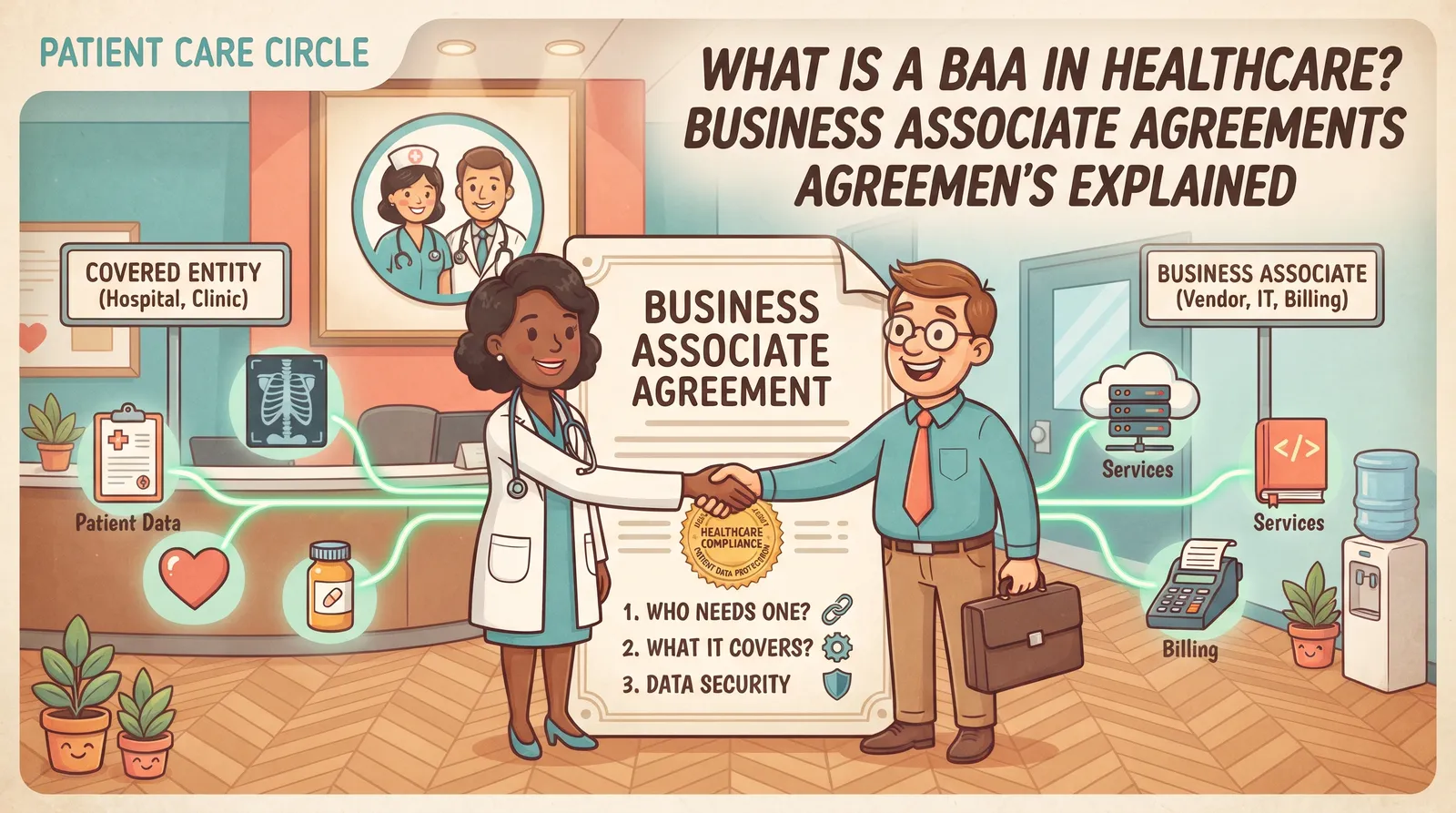
A BAA (Business Associate Agreement) is a written contract required under HIPAA between a covered entity (such as a therapist or healthcare provider) and a business associate — any outside person or company that creates, receives, maintains, or transmits protected health information (PHI) on the provider's behalf.
In short: if you hand patient data to a vendor so they can do work for you, HIPAA generally requires a signed BAA that spells out how that vendor will protect the information and what they can and can't do with it. [Needs clinician review]
BAA Meaning and Acronym Breakdown
BAA stands for Business Associate Agreement. You may also see it written as a "Business Associate Contract." As a medical abbreviation, BAA almost always refers to this HIPAA document in a privacy and compliance context.
Breaking it down:
- Business Associate — a vendor or partner that handles PHI for a covered entity.
- Agreement — the legally binding contract that defines how that PHI is protected and used.
So when someone refers to "the BAA," they mean the signed agreement that governs the relationship between a provider and a PHI-handling vendor.
Who Needs a BAA? Covered Entities vs. Business Associates
Two roles matter here, and HIPAA defines both. The following restates HIPAA concepts in plain language; confirm the exact regulatory definitions with a compliance professional. [Needs clinician review]
Covered entities generally include:
- Healthcare providers who transmit health information electronically in connection with certain transactions (this typically includes most private-practice therapists who bill electronically)
- Health plans
- Healthcare clearinghouses
Business associates are outside parties that perform functions involving PHI on a covered entity's behalf — for example, a billing company, an EHR vendor, or a secure messaging platform.
A BAA is required whenever a covered entity shares PHI with a business associate so that associate can perform services for the practice. Business associates may also need BAAs with their own subcontractors who touch PHI — this is often called "flow-down." (45 CFR § 160.103 – Definitions (Code of Federal Regulations, via Cornell Law School's Legal Information Institute))
What Does a BAA Actually Cover?
A BAA translates HIPAA obligations into contract terms. While specific agreements vary, they generally address the following areas. Confirm the required elements against current HIPAA rules before relying on this list. [Needs clinician review]
- Permitted uses and disclosures of PHI — what the business associate is (and isn't) allowed to do with the data.
- Safeguards — a commitment to use appropriate administrative, physical, and technical protections for PHI.
- Breach notification — the obligation to report security incidents or breaches, and within what timeframe.
- Subcontractor terms — a requirement that any subcontractors who handle PHI agree to equivalent protections.
- Return or destruction of PHI — what happens to the data when the relationship ends.
(Business Associate Contracts (HHS.gov — Sample Business Associate Agreement Provisions))
Common Business Associates for a Private Therapy Practice
This is where small and solo practices get tripped up. You may use more PHI-handling vendors than you realize. Here are categories that commonly require a BAA for a behavioral-health practice:
- EHR / EMR systems — store clinical records and notes.
- Billing services and clearinghouses — process claims containing patient data.
- Scheduling software — if it holds patient names, contact details, or appointment data.
- Secure messaging and document/referral sharing tools — anything used to communicate PHI with other providers.
- Telehealth platforms — video and messaging tools used for sessions.
- Cloud storage and backup services — if PHI is stored or synced there.
- Answering services and transcription services — if they receive patient information.
A good rule of thumb: if a vendor can see, store, or transmit any patient information on your behalf, ask whether you need a BAA with them. (Note that a free consumer email or video app that isn't offered under a BAA generally should not be used for PHI.)
Is a BAA Required for HIPAA Compliance?
Generally, yes — a BAA is required whenever you share PHI with a vendor acting as a business associate. There are narrow exceptions. For example, entities that merely transport data without accessing it (sometimes described under the "conduit" exception, such as the postal service or certain internet service providers) may not be treated as business associates. These exceptions are narrow and frequently misunderstood, so verify any exception with a compliance professional before relying on it. [Needs clinician review] (HIPAA Conduit Exception Rule - what is it?)
BAA vs. Data Use Agreement (DUA): What's the Difference?
These two documents are easy to confuse, but they serve different purposes:
- BAA (Business Associate Agreement): Governs a vendor handling PHI to perform services for a covered entity.
- DUA (Data Use Agreement): Typically used when sharing a limited data set — data stripped of most direct identifiers — often for research, public health, or healthcare operations purposes.
For a typical private-practice therapist, the BAA is the document you'll encounter far more often. DUAs tend to come up in research or large-institution contexts.
What to Check Before Signing a Vendor's BAA
Before you adopt a new tool, treat the BAA as part of your vetting — not an afterthought:
- Does the vendor offer a BAA at all? If a tool handles PHI but won't sign one, that's a red flag for use with patient data.
- What does the BAA actually cover? Read the permitted uses and safeguards language.
- How are breaches handled? Look for clear notification obligations and timeframes.
- Are subcontractors addressed? If the vendor uses other services (like cloud infrastructure), check that PHI protections flow down.
- Is it easy to obtain and sign? Reputable HIPAA-focused vendors make their BAA straightforward to request and execute.
Keep a signed copy of every BAA on file as part of your compliance documentation.
What Happens If You Don't Have a BAA?
Sharing PHI with a business associate without a required BAA is a HIPAA compliance gap. Rather than focusing on worst-case scenarios, think of it practically: a missing BAA means there's no contract defining how your patients' data is protected once it leaves your hands, and no agreed process if something goes wrong. That's a risk to both your patients and your practice. We've avoided citing specific penalty figures here because enforcement details change and depend on circumstances; confirm current enforcement guidance with a compliance professional. [Needs clinician review] (HIPAA Enforcement)
How Secure Messaging and Care Coordination Tools Fit In
When you coordinate care with other providers around a shared patient, you're often sharing PHI — referral notes, updates, documents. Doing that over ordinary email or consumer messaging apps isn't appropriate for PHI.
This is where a purpose-built, HIPAA-compliant secure messaging and care-coordination tool fits in. Patient Care Circle (PCC) is built for behavioral-health providers to communicate and share documents and referrals securely, with the goal of reducing fragmented care across a patient's care circle — and PCC offers a BAA to the practices that use it. (HIPAA, Security Risk Assessments, and the Pediatric Practice — PCC Learn)
Choosing tools that offer a BAA is one piece of a practice's broader compliance approach — not a substitute for your own clinical and professional judgment.
FAQ
What does BAA stand for? BAA stands for Business Associate Agreement — a HIPAA-required contract between a covered entity and a vendor that handles protected health information on its behalf.
Is a BAA required for HIPAA compliance? Generally, yes. A BAA is required whenever a covered entity shares PHI with a business associate. Narrow exceptions exist (such as the conduit exception), so confirm your situation with a compliance professional. [Needs clinician review]
Can you give an example of a business associate of a HIPAA covered entity? Common examples include an EHR vendor, a billing or claims clearinghouse, a secure messaging platform, a telehealth service, or a transcription service — any outside party handling PHI on the provider's behalf.
What are the 5 main HIPAA rules? HIPAA is commonly described in terms of several rules, including the Privacy Rule, the Security Rule, the Breach Notification Rule, the Enforcement Rule, and the Omnibus Rule. Confirm the exact framework and current terminology with a compliance professional. [Needs clinician review] (Combined Regulation Text of All Rules)
Does a solo private-practice therapist need a BAA? If you're a covered entity and you share PHI with outside vendors (EHR, billing, secure messaging, etc.), then yes — you generally need a BAA with each of those business associates.
What happens if a vendor won't sign a BAA? If a vendor handles PHI but won't provide a BAA, that's a strong signal not to use it for patient data. Look for a HIPAA-focused alternative that offers one.
How is a BAA different from a Data Use Agreement? A BAA governs vendors handling PHI to perform services for you. A DUA typically covers sharing a limited data set (with most direct identifiers removed), often for research or operations.
Disclaimer
This article is for general educational purposes and is not legal or compliance advice. Patient Care Circle is a communication tool and is not a substitute for clinical judgment or emergency services, and using any tool does not by itself guarantee HIPAA compliance. For guidance on your specific obligations, consult a qualified healthcare attorney or compliance professional.
Frequently asked questions
What does BAA stand for?
BAA stands for Business Associate Agreement — a HIPAA-required contract between a covered entity and a vendor that handles protected health information on its behalf.
Is a BAA required for HIPAA compliance?
Generally yes. A BAA is required whenever a covered entity shares PHI with a business associate. Narrow exceptions exist, such as the conduit exception, so confirm your situation with a compliance professional.
Can you give an example of a business associate of a HIPAA covered entity?
Common examples include an EHR vendor, a billing or claims clearinghouse, a secure messaging platform, a telehealth service, or a transcription service — any outside party handling PHI on the provider's behalf.
What are the 5 main HIPAA rules?
HIPAA is commonly described in terms of the Privacy Rule, the Security Rule, the Breach Notification Rule, the Enforcement Rule, and the Omnibus Rule. Confirm the exact framework and current terminology with a compliance professional.
Does a solo private-practice therapist need a BAA?
If you are a covered entity and you share PHI with outside vendors such as an EHR, billing service, or secure messaging tool, you generally need a BAA with each of those business associates.
What happens if a vendor won't sign a BAA?
If a vendor handles PHI but won't provide a BAA, that is a strong signal not to use it for patient data. Look for a HIPAA-focused alternative that offers one.
How is a BAA different from a Data Use Agreement?
A BAA governs vendors handling PHI to perform services for you. A DUA typically covers sharing a limited data set, with most direct identifiers removed, often for research or operations.
Sources
- 45 CFR § 160.103 – Definitions (Code of Federal Regulations, via Cornell Law School's Legal Information Institute)
- Business Associate Contracts (HHS.gov — Sample Business Associate Agreement Provisions)
- HIPAA Conduit Exception Rule - what is it?
- HIPAA Enforcement
- HIPAA, Security Risk Assessments, and the Pediatric Practice — PCC Learn
- Combined Regulation Text of All Rules