Communication Barriers in Healthcare: The Provider-to-Provider Gap Most Guides Miss
A practical guide to communication barriers in healthcare—especially provider-to-provider gaps that fragment care—plus fixes for small practices.

Most guides to communication barriers in healthcare focus on one relationship: clinician and patient. That matters—but it leaves out the breakdowns that quietly fragment care every day: the ones between providers. A referral that never gets followed up. A psychiatrist and a therapist treating the same person who never actually talk. Records scattered across inboxes, fax machines, and voicemails.
This guide covers the full picture. We'll walk through the classic taxonomy you'd expect, then spend real time on the provider-to-provider and digital barriers that other guides skip—and give solo and small behavioral-health practices a practical framework to reduce them.
A note before we start: This article is general information for providers and practice staff, not clinical or legal advice. Secure communication tools support coordination; they don't replace clinical judgment or emergency services.
Communication barriers in healthcare, explained
A communication barrier is anything that prevents a message from being sent, received, or understood as intended. In healthcare, those barriers show up in two directions:
- Provider-to-patient: the clinician explaining a diagnosis, instructions, or a treatment plan—and the patient understanding and acting on it.
- Provider-to-provider: the clinicians, specialists, and staff involved in one person's care staying aligned with each other.
Almost every popular guide covers the first direction thoroughly and barely mentions the second. Yet when a patient sees a primary care physician, a psychiatrist, and a therapist—often across unconnected systems—the gaps between those providers are where coordination tends to break down. We'll give you the standard taxonomy first, then focus on the overlooked channel.
The four main types of communication barriers
Most frameworks group barriers into four broad categories. They overlap in practice, but the taxonomy is useful for diagnosing where a breakdown is actually happening.
Physical and environmental barriers
These are the tangible obstacles in the room—or across the distance.
- Noise and interruptions in busy clinical settings make it hard to hear or concentrate.
- Time pressure compresses conversations so that key details get dropped.
- Physical distance between providers on a shared case, when there's no shared channel to reach one another.
- Sensory factors such as hearing or vision differences that aren't accommodated.
These are often the easiest to fix: a quieter space, a few more minutes, or a reliable way to reach a colleague.
Language and health-literacy barriers
When a patient has limited English proficiency (LEP) or limited health literacy, even accurate information can fail to land.
- Use qualified medical interpreters rather than family members for clinical conversations.
- Apply the teach-back method—ask the patient to explain the plan back in their own words—to confirm understanding rather than assuming it.
- Provide materials written in plain language and, where appropriate, in the patient's preferred language.
Cultural and perceptual barriers
Differences in background, expectations, and beliefs shape how a message is received.
- Differing expectations about the clinician's role, treatment, or decision-making.
- Implicit bias and assumptions that affect how information is given or interpreted.
- Stigma around mental health, which can make patients reluctant to share or follow through—and can make coordination between providers more sensitive.
Approaching these conversations with cultural humility and curiosity, rather than assumptions, helps keep the channel open.
Emotional barriers
Emotion—on either side of the conversation—can interfere with clear communication.
- Patient fear or anxiety can make it hard to absorb or retain information.
- Clinician stress and burnout can contribute to rushed handoffs, missed details, and reduced follow-through.
Naming and accounting for the emotional context is part of communicating well, not separate from it.
The barrier most guides skip: provider-to-provider communication
Here's the gap. A patient's care rarely lives with one provider. In behavioral health especially, a single person may be working with a primary care physician, a prescribing psychiatrist, and one or more therapists—plus a case manager or school counselor. When those providers can't communicate cleanly, care fragments. Common failure points include:
- Confusing or incomplete handoffs. When a case moves between providers, important context gets lost if there's no consistent format for passing it along.
- Referral drop-off. A referral is made, but there's no closed loop confirming the patient connected, was seen, or what came of it.
- Fragmented records. Each provider holds a piece of the picture in a separate system, and no one sees the whole.
- No shared channel. Without a secure, agreed-upon way to reach each other, providers fall back on phone tag, fax, or—riskily—personal email and text.
The result is fragmented care: not a single dramatic failure, but a steady accumulation of missed context and duplicated effort. The fix isn't heroic; it's structural. A shared, secure way for a patient's providers to communicate reduces that fragmentation. (It supports coordination—it doesn't replace clinical judgment.)
Why fragmented communication is worse in behavioral health
Behavioral-health practices face a particular set of conditions that make provider-to-provider gaps harder to close.
- Solo and small practices often lack the IT infrastructure and shared records that a large hospital system takes for granted.
- Care is distributed across outside providers—the prescriber, the therapist, and the PCP may all be in different organizations with no common system.
- Privacy and consent are especially sensitive. Behavioral-health information often carries heightened confidentiality expectations, which makes how providers share information as important as whether they do.
- No shared EHR means coordination frequently happens through whatever channel is handy—which is often not secure or compliant.
Rules governing consent, information-sharing between providers, and records retention vary by state and by the type of information involved, and some categories of behavioral-health records carry additional protections. Confirm the specific requirements that apply to your practice and jurisdiction before adopting a workflow.
Digital and telehealth communication challenges
Telehealth expanded access, but it also introduced its own communication challenges—and some new risks.
- Connection and technology issues. Dropped calls, lag, and audio problems interrupt conversations and can cause details to be missed.
- Reduced nonverbal cues. A screen strips away body language and context that clinicians rely on, which matters a great deal in behavioral health.
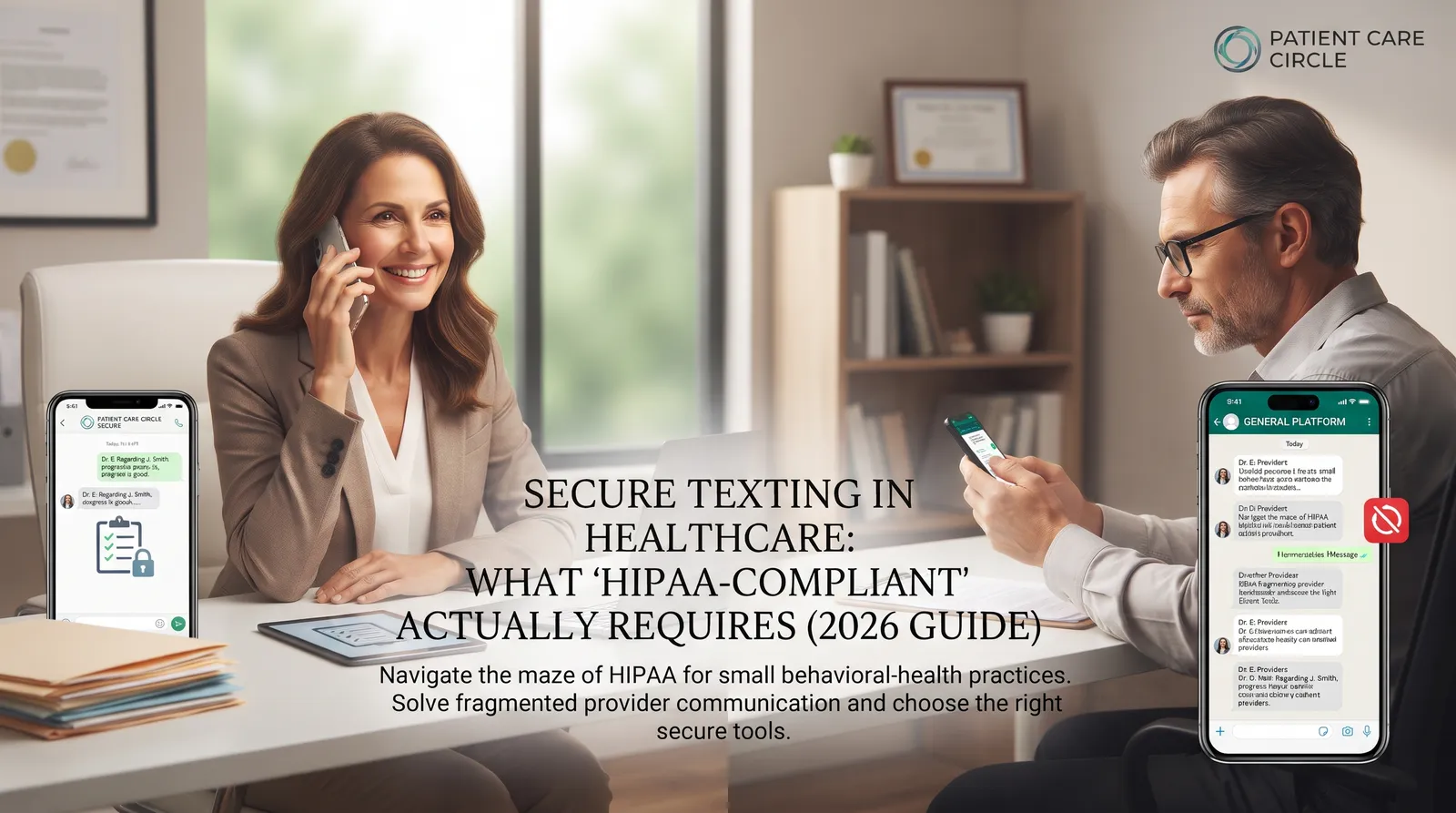
- Insecure channels. Standard personal email and SMS text messaging are not HIPAA-compliant ways to exchange protected health information. Convenience often pushes providers toward tools that aren't appropriate for clinical content.
- Tool sprawl. Juggling separate apps for video, messaging, and document sharing creates gaps where information falls through.
The through-line: telehealth makes a secure, purpose-built communication channel more important, not less.
How to reduce communication barriers: a practical framework for small practices
Most guides stop at naming the problems. Here's a diagnose-and-fix sequence a solo or small practice can actually run.
- Map the care circle. For each patient, write down who else is involved—PCP, prescriber, other therapists, case managers. You can't coordinate with people you haven't identified.
- Standardize handoffs and referrals. Adopt a consistent format for what information travels with a referral or handoff, and build in a step to close the loop (confirm the patient connected and capture what happened).
- Use a secure channel. Replace personal email and text with a HIPAA-compliant tool for any communication involving protected health information. This is where provider-to-provider messaging and secure document sharing do the most good.
- Confirm understanding. With patients, use teach-back. With other providers, confirm receipt and shared understanding of the plan rather than assuming a sent message was read and understood.
- Document consent and information-sharing. Make sure you have appropriate consent for sharing information with the rest of the care circle, and document it. (See the state-specific caveat above.)
None of these steps requires a hospital's budget. They require a clear process and a secure place to run it.
Where secure messaging fits (and where it doesn't)
Patient Care Circle (PCC) is a HIPAA-compliant secure messaging tool built for behavioral-health providers who coordinate care with others. It's designed to address the provider-to-provider gap specifically: a secure channel for messaging the other clinicians in a patient's care circle, plus secure referral and document sharing—so context travels with the patient instead of getting stranded in separate inboxes.
Used well, that reduces the fragmented-care problems described above: cleaner handoffs, closed referral loops, and one secure place to coordinate rather than scattered emails and faxes.
What it doesn't do: PCC is a communication tool. It is not a substitute for clinical judgment or for emergency services. It supports coordination between providers; the clinical decisions remain yours.
Frequently asked questions
What are the main communication barriers in healthcare?
They're commonly grouped into four categories: physical and environmental (noise, time pressure, distance), language and health-literacy, cultural and perceptual, and emotional. Beyond these provider-to-patient barriers, there's a frequently overlooked category: provider-to-provider breakdowns such as unclear handoffs, referral drop-off, and fragmented records.
What causes communication breakdowns between healthcare providers?
Common causes include confusing or incomplete handoffs, referrals that never get a follow-up, records split across unconnected systems, and the absence of a shared, secure channel for a patient's providers to reach one another. These are especially common when care is distributed across separate organizations—as it often is in behavioral health.
What are the biggest challenges in telemedicine communication?
Connection and technology problems, the loss of nonverbal cues over a screen, and the temptation to use channels that aren't secure or HIPAA-compliant. Using too many disconnected apps also creates gaps where information can fall through.
Is texting or email a HIPAA-compliant way to coordinate patient care?
Standard personal SMS text and ordinary email are generally not HIPAA-compliant for exchanging protected health information. Coordinating care involving PHI should happen through a secure, compliant tool designed for that purpose. Confirm the specific requirements that apply to your practice.
How can a small or solo behavioral-health practice reduce fragmented care?
Start by mapping each patient's care circle, standardize how handoffs and referrals travel (and close the loop on them), move provider-to-provider communication to a secure channel, confirm understanding rather than assuming it, and document consent for information-sharing. These steps don't require a large organization's resources—just a clear process and a secure place to run it.
Frequently asked questions
What are the main communication barriers in healthcare?
They're commonly grouped into four categories: physical and environmental (noise, time pressure, distance), language and health-literacy, cultural and perceptual, and emotional. Beyond these provider-to-patient barriers, there's a frequently overlooked category: provider-to-provider breakdowns such as unclear handoffs, referral drop-off, and fragmented records.
What causes communication breakdowns between healthcare providers?
Common causes include confusing or incomplete handoffs, referrals that never get a follow-up, records split across unconnected systems, and the absence of a shared, secure channel for a patient's providers to reach one another. These are especially common when care is distributed across separate organizations, as it often is in behavioral health.
What are the biggest challenges in telemedicine communication?
Connection and technology problems, the loss of nonverbal cues over a screen, and the temptation to use channels that aren't secure or HIPAA-compliant. Using too many disconnected apps also creates gaps where information can fall through.
Is texting or email a HIPAA-compliant way to coordinate patient care?
Standard personal SMS text and ordinary email are generally not HIPAA-compliant for exchanging protected health information. Coordinating care involving PHI should happen through a secure, compliant tool designed for that purpose. Confirm the specific requirements that apply to your practice.
How can a small or solo behavioral-health practice reduce fragmented care?
Start by mapping each patient's care circle, standardize how handoffs and referrals travel (and close the loop on them), move provider-to-provider communication to a secure channel, confirm understanding rather than assuming it, and document consent for information-sharing.